- 1822 Arrival in NSW
Edward Markham, sentenced to 7 years under the Irish Insurrection Act, 1822, arrived Sydney on the Mangles on 8.11.1822. [1] He was forwarded by river direct to Parramatta from the ship on 12 November, with 116 other convicts, Markham to be assigned to James Byrne of Appin (who also had land in Evan, now Penrith). [2] We are still unclear whether he took up duty with Byrne,and if so, whether at Appin or Evan. We have no record of his assignment apart from this assignment document , until he started with John McHenry on 21 August, 1824.
Robert Hughes wrote in “The Fatal Impact” : Each convict served a fixed term of punishment and then became free. None was a chattel, the property of a master. All of them, within limits, had the right to sell some portion of their labor on the free market. Harsh and rigorous as their social world often was, it was enlaced by concepts of right and law, not of simple ownership. They could appear as witnesses in court, bring suits in civil law, and write petitions to the governor, which were given full and usually prompt consideration. Their masters did not have the right to flog them; such punishments could only be inflicted by the sentence of a magistrate, or, in later years, two magistrates. A convict could bring a master to court for ill treatment. Often, when they had served their terms, convicts were given land and assigned convicts to work it. Their children were born free. They could not vote but neither could anyone else in New South Wales until after 1840. If this was slavery, as its critics insisted, it was not of a kind recognizable in Barbados or Atlanta, let alone in ancient Athens, Rome or Luxor.
It had its own name: the assignment system. Most convicts were “assigned”- lent out, as laborers, by the government-to private settlers. A few, perhaps one in ten, were kept by the government to labor on public works, digging ditches and tunnels, building jails, courthouses, stores and breakwaters, making roads through the bush. Thus the “government man”-a favorite euphemism in a society where the word “convict” was rarely used-could serve the Crown directly and pay back his debt to English society. Government labor was thought the worse punishment. But assignment was the staff of colonial life for the first fifty years of European settlement. It shaped the colony and molded its social institutions, and it was one-if not quite the main reason why emigrants went there at all.
Penal Australia was too distant, weird and tainted to attract many free immigrants from the working class. However, its government hoped to bring in “opulent” settlers, men of capital who would spend it in the colony, with offers of free land and free labor. In its unexplored vastness, the colony was glutted with land, and the government gave it away. \
THE FATAL IMPACT by ROBERT HUGHES.
- 1823 Did he really arrive at Milburn Creek in 1823?
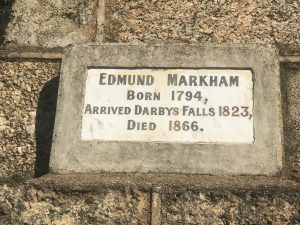
This plaque commemorating the first Markham, Edmund, was placed on the monument in about 1920. The arrival date of 1823 connot be confirmed. He was assigned to oh though he was certainly there by 1830s.
Constructed ca. 1916 for the interment of Edmund’s son, James , died 1913 Plaque stating “Born 1794, Arrived Darbys Falls 1823” was added at a later unknown date. Did he really visit the Lachlan in 1823? The claim of 1823 arrival is doubtful, as is his date of birth as recorded. He was born in 1802. If we can establish his employer in 1823 we may solvetheproblem. Many people were taking up land in the area at the time. These included John McHenry (See 1824 below) and Rev Henry Fulton[ [3] (which he called Mufflon Park,but now called Jerula) close to what became Cowra, 14 miles away on the now called Darbys Falls Road.) with whom he had close involvement in future years.
The first grants of land were made in 1827 (George Rankin at ‘Glen Logan”in 1827), but there had been many “squatters” in the area for yars before that so we cannotrule out thepossibility that Markham visited the ara i or those earlier years. Given that some 100 years had passed since his arrival in NSW and almost 50 years since his death, and noting the birth date error, one must, without any other proof, treat the 1823 date with caution.We know he was settled on Milburn Creek prior to 1836, when James was born. He left Sydney in 1830, so our only certainty is the first half of the 1830s
T
- 1823 to 1824 Where was Markham in 1823/1824?
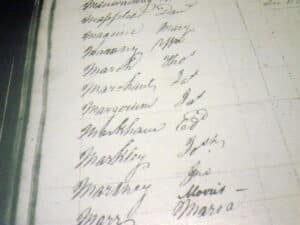 Edward/Edmund now in Parramatta, there to be assigned to James Byrne of Appin (who also had land in Evan, now Penrith). We are still unclear whether he took up duty with Byrne, and if so, whether at Appin or Evan. We have no record of his assignment priortothe date until he started with John McHenry at Evan, now Penrith on 21 August, 1824
The only success I have had searching for his whereabouts in 1823/1824 has been his name in the Windsor Constable’s Notebook.[4] The list was certified by Wm Cox at the time.
“ The persons accounted for in this book mustered at Windsor in 1823 but not 1824.’ so he wa in the Windsor area before 21 Augustv1824.
These notebooks were prepared during preparations for a census and other record keeping in the Colony. Most of those I have seen have been made house by house, farm by farm etc so it has been possible to link assignees with their employer. Unfortunately the list on which I found Markham’s name had been transcribed alphabetically for the district, making it almost impossible to identify his location at the time. Could he have been assigned to Cox at the time, though there were many otheremployers in Windsor at the time.
- 1824 IN THE EMPLOY OF JOHN MCHENRY. [5]
Edmund Markham was “received in service” of John McHenry at Evan on August 21, 1824.[6] He spent some five + years with McHenry, listed as ‘Overseer’ in the 1828 Census. It is possible that during this time he first visited the Lachlan River. Is there any evidence that McHenry owned or leased land there? Most likely, since the 1828 Census recorded that his friend also from Mangles, was assigned to McHenry as a “stockman at Bathurst.” Moreover, McHenry’s father – in – law Rev. H. Fulton (who with McHenry gave references in Markham’s favour in 1830 when he applied for land) owned land on the Lachlan, acquired some time before 1837, adjacent to what is now Cowra, at the point where the Waugoola Creek meets the Lachlan River . (Dixon Map of NSW 1837 drawn in 1829.) Both Fulton and McHenry are listed as property holders on the same map, in the Brisbane Valley, south east of Bathurst. Would Edward have visited.
- 1825 JOHN McHENRY’S ASSIGNED SERVANTS
Sir, The records of this office having been examined in consequence of your late Memorial, it appears that not more than fifteen convicts who are named in this margin were in your service at both the last Musters, I am instructed therefore to acquaint you that no grant of land can be made to you in addition to the two thousand acres which you possess at present.
I have the honour, etc etc, F Goulburn To John McHenry, Esq.
John Boles; Wm Boulter; Henry Russell; Tim Callaghan; Thomas Cassidy; George Godfrey; Patrick Harrington; George Healy; Terence Hickey;
Andrew Langley; Jonathan Donald; Edward Markham; Samuel North; John Whalan; James Wolfenden.
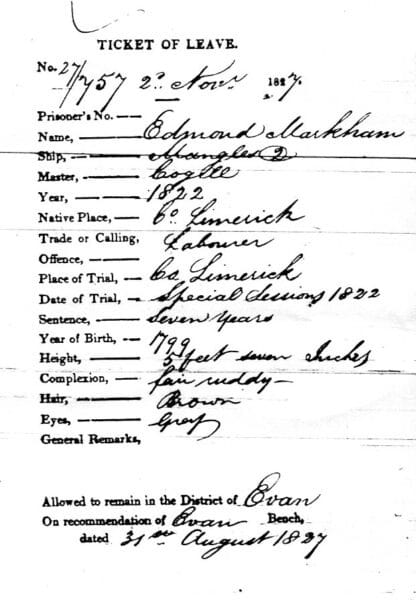
- 1827 TICKET OF LEAVE
As wa usual where transportees had no disciplinary or other problems since arrival in the Colony, Markham received his Ticket of Leave on 2 November, 1827 [7] PUBLIC NOTICE Tickets of Leave, , viz., The Ticket of Leave enabled the grantee to leave assigned service and work for himself. Despite this, Markham remained working for McHenry, for three more years, presumably as a free man.
- 1828 N S W CENSUS
Edward Markham , Age 29 (sic), Ticket of Leave, Mangles 1822, 7 years, Catholic, Occupation: “Overseer” ( to John McHenry, EVAN) .
- 1829 CERTIFICATE OF FREEDOM
His Certifcate of Freedom came two years later on 19 May, 1829 [8] It is interesting that the personal details varied in some respects from those listed in the Ticket of Leave. Edmond became Edward; Year of birth was corrected to 1802; height was raised by 1/2 inches. He left McHenry’s service 7 months later, free to travel anywhere in the Colony.
- 1830 PETITION TO GOV. DARLING FOR LAND GRANT
Edmund Markham’s petition to Governor Darling of 2 March, 1830, for land, states he
“is 28 years old (Note:i.e.born 1802) , unmarried is free by servitude, that he has never had any land from Government by Grant, purchase, or otherwise, and that he has no land of his own whatever, but should your Excellency be pleased to confer on him a Grant he would reside in, and improve it. That (he)has been eight years in the Colony, during which period; he has borne an irreproachable character as the annexed testimonials will shew. That (he) possesses two horses, and 10 head of homed cattle, [Where? FCM] and other available means to cultivate and improve. His address is ‘District of EVAN’. [9]
There were two notations onthedocument:
I believe the foregoing statement to be true. (sgd) J MacHenry JP; and
I also believe the same. (sgd) Henry Fulton.
Giving his location as Gloster (Sic) St,Sydney, Markham sent a reminder to the Governor’s Private Secretary, Captain Dumaresque on 28 April 1830. he states:
‘I am a Constable at present, belonging to no. 1 District, quite destitute of any residence or place for my cattle…’ [10]
A marginal note states
‘Intends to quit his present situation of Constable. A farmer. Has 10 head of cattle, 2 mares.’ Another note states “Employment with ? . Free by servitude. Nothing extraordinary.”
All this came to nothing. The then Governor Darling opposed all emancipists and wanted to deny them any political (and land) rights, on the ground that, once convicted, they were perpetual felons. (Roberts: The Squatting Age in Australia.)It appears that, in the light of Governor Darling’s treatment of emancipists, applications were ignored, and no (written) reply was given to applicants. See item at 1831 below noting the 50 or so replies given following Governor Darling’s departure and his successor’s variation of the land grant/sale rules, at the same time reversing his predecessor’s approach to emancipists.
Although his Land Grant application of 2.3.1830 stated his address as EVAN, his reminder of 28.4.1830 stated his address as ‘Gloster St”- (i.e Gloucester St in The Rocks, Sydney.) He had just been made free after completing his term assigned to John McHenry. Perhaps he left McHenry’s employ and moved (newly appointed to the Police) immediately to ‘No 1 Police District’, [11]taking up accommodation at Gloucester St, some time between 2 March and 28 April, 1830.
Since we do not yet know when he “went bush” (though let’s not forget he had cows and horses somewhere) he may have stayed in Gloucester Street for some time, though we know he intended to leave police service even as he started. There was at the time a boarding house at 95 Gloucester St. A pub, the Limerick Arms was two blocks south in the same street.. “William Curtayne Publican at the Limerick Arms, Gloucester Street. William Grum gave “William Curtain” as a relative at Brisbane Water on his Emigrant Application in 1845. Any link to Curtayne?
· PART OF THE IRISH COMMUNITY IN SYDNEY
Markham was one of “Officers of Government, 37 Magistrates, and 1,400 professional men, merchants and householders who signe the petition of March 1830 for the reinstatement of Fr J J Therry [12]as Government Chaplain.” [13].
Furthermore, he donated one pound to Fr Therry’s 1830 Appeal to build St Mary’s Chapel.[14]
- 1830 HIS SHORT SERVICE IN THE POLICE IN THE 1830s.
A Government statement recorded that he joined the Police of the Colony from 30 March 1830.[15] He was recorded in a later statement aas having resigned from the service on 30 June 1830.
. Note the marginal note on his letter, dated 28 April 1830, to Captain Dumaresque. As it turned out
‘Intends to quit his present situation of Constable. A farmer. Has 10 head of cattle, 2 mares.’
“Where, then, did he go? Where, at the time of writing his Petition in April 1830 did he keep his cattle and horses? It is likely that he went straight from Sydney in 1830 to Milburn Creek, [16] taking land as a Squatter from the very early 1830s, until grants were to be made later in the decade. The whole matter is covered more comprehensively in my article Milburn Ck Pioneers – Markham or Jordan.
- 1831 TERMINATION OF SYSTEM OF GRANTS OF LAND
We have not seen a reply, if any, to Edmund Markham’s application of March 1830, to Governor Darling, but apparently fifty or more applicants received a letter of refusal at the same time, which read, in the example to Ned Ryan of Galong Castle, (who had applied also in March, 1830), as follows: Colonial Secretary’s Office, dated October 21, 1831.
In reply to your application of 17th March, 1830, for a Grant of Land, I am directed by His Excellency the Governor to inform you that your request cannot be complied with. By His Exc etc, T C Harington]
“By edict of 1 July, 1831 Governor Bourke decreed that ‘in future, no land will be disposed of in NSW or Van Dieman’s Land, otherwise than by public sale…all land in the colony not granted and not appropriated for public purposes will be put up for sale by auction at not less than 5/- per acre’. (Some Came Free, by E G Hazell.)
To 1832 to 1839 Working on the later periods.
_________________________________________________
- During the 1822 – 1824 period of the UK’s “political” Irish Insurrection Act of 1822, there were 4000 arrests, though only 507 convictions, of whom 452 were transported, in all cases for seven years. Edmund Markham was from Limerick where there were 785 arrests, 181 convictions, and 179 transported.↵
- Colonial Secretary’s Correspondence 1788-1825 Reel 6009 page 431 dated 12 November, 1822.↵
- Rev Henry Fulton, who was Magistrate and Assistant Chaplain, and who, incidentally, signed, along with McHenry, a letter supporting Markham’s freedom, and sons formed a Station on the Lachlan River near the present day Cowra. He was an Irish Exile who arrived on the “MINERVA” 11.1.1800, exiled for his part inthe Irish Rebellion of the 1798s. Fulton’s daughter Sarah was married to McHenry. The site of the Fulton land is shownon Dixon’s 1845 (but drawn in 1829) map of the Lachlan. Apart from a Wm Redfern block there appears to be little nearby settlement,and nothing on Milburn Creek.↵
- Signed by Wm Cox JP on 21.12.1824. at Windsor Court House.↵
- John McHenry, Magistrate, Pioneer died 8.9.1832 age 43. The 1828 Census recorded that McHenry 38 came free on the ‘Mary’ in 1819 His wife, Sarah, 27 was born in the colony. Two children. Landholder EVAN (2600 ac. 400 cleared, 300 cultivated, 38 horses, 618 horned cattle, 620 sheep). 27 employees. Operated a flour mill at ‘Lambridge’ on the Nepean, probably after 1830. At the time McHenry had two properties, the other near (S.E.? of) Bathurst with 5 employees.↵
- Return of Government Servants employed and maintained by John McHenry Esq. Page 636.↵
- Ticket of Leave 27/757 of 2 November, 1827. Reel910 Item 4/4065. Sydney Gazette of 2 November 1827↵
- Certificate 29/0413 of 4.5.1829. (SR Ref 4/4297 Film 984) Sydney Gazette 19 May 1829↵
- CSIL 30/2309 of 2 March 1830 Reel 1156 Page 154.↵
- CSIL5110 of 30 June 1830.Reel 1156↵
- First Police District from Dawes Pt in the North to Surrey Lane (inclusive) and extending from Sydney Cove on the east to to Cockle Bay on the wes.In 1830 the Superintendant was Capt. F N Rossi.↵
- Father Therry (1790 – 1864) arrived in Sydney in May, 1820 and for the next thirteen years was the most important – and more often the only – priest in Australia. Approved by Macquarie, favoured by Brisbane, but in constant conflict with Darling, he was suspended from his official (paid by Govt) post by Darling in 1827. It was not until Darling was replaced by Bourke and Catholic emancipation was achieved in England that a Petition (drawn up in March 1830 and forwarded on his arrival) to Governor Bourke seeking the restitution of Father Therry to his official paid Chaplaincy. [Australian Encyclopaedia.↵
- Foundation of Catholicism in Australia’ Eris O’Brien. Account of the petition on p. 132 Vol 1↵
- Papers of Fr J Therry in NSW State Library. 3 May 1820 and on 29 October of that year Governor Macquarie laid the foundation of a chapel named St Mary’s. Father Therry wanted his new chapel built in The Rocks area but Macquarie gave him land close by the Convict Barracks..↵
- Colonial Secretary’s Office, Sydney. 7 April, 1830. Also in The Australian of 9.4.1830.↵
- DISCOVERY OF MILBURN CREEK: Although Evans and Oxley had ‘discovered’ the lower Lachlan in 1815 – 1817, it was Deputy Surveyor General, James Meehan, himself an emancipist, who, in 1820, with 5 men, became the pioneer explorer of the Upper Lachlan. Meehan reached the headwaters of the Lachlan, south of present day Crookwell, on 24 April, 1820, went along the Lachlan to Hovell’s Creek on 28 April, passed the junction of the Abercrombie, and crossed the Lachlan about two miles above the junction of Milburn Creek ……[Cowra on the Lachlan: Marriott]↵